Spend Visibility: The Financial Imperative Higher Education CFOs Can No Longer Ignore
By E&I Cooperative Services
Executive Takeaway
For CFOs, spend visibility is not simply a procurement initiative – it’s a financial strategy. Institutions that can clearly see where and how money is spent are better positioned to control costs, reduce risk, improve operational efficiency, and redirect resources toward their mission. In an era of enrollment uncertainty and rising operating costs, spend visibility becomes a real competitive advantage.
Higher education is facing a perfect storm of financial pressure. Operating costs continue to climb, funding sources are becoming increasingly unpredictable, and institutional leaders are being asked to do more with less. Every budget cycle seems to bring new uncertainty, yet expectations for student success, academic excellence, and operational efficiency remain unchanged.
In this environment, CFOs cannot afford to focus solely on revenue challenges. An equally important question deserves immediate attention:
How much of your institution's spend is happening beyond your line of sight?
For many colleges and universities, the answer is alarming. Millions of dollars flow through decentralized purchasing channels every year with limited visibility, creating hidden inefficiencies that quietly drain resources and weaken financial performance.
The Most Expensive Problem Is the One You Can't See
Finance teams rigorously review major capital investments, technology initiatives, and staffing decisions. Yet countless day-to-day purchases occur across campuses with little enterprise-level oversight.
Purchasing card transactions, supplier invoices, departmental budgets, contracts, and accounts payable systems often operate independently, creating fragmented data and incomplete financial visibility. The result is a procurement ecosystem where duplicate purchases, inconsistent pricing, supplier sprawl, and contract leakage can thrive unnoticed.
The danger isn't a single $200 purchase. It’s the hundreds – or thousands – of similar purchases occurring across dozens of departments, year after year, without a coordinated strategy.
The danger isn't a single $200 purchase.
It’s the hundreds – or thousands – of similar purchases occurring across dozens of departments, year after year, without a coordinated strategy.
When spending remains hidden, so too, do opportunities for savings.
Visibility Is No Longer a Procurement Goal – It's a Financial Strategy
For years, procurement has been viewed primarily as an operational function. The financial realities of today demand a very different perspective.
Institutions that achieve comprehensive spend visibility gain the ability to control costs more strategically, leverage their purchasing power more effectively, and align spending decisions with institutional priorities.
The institutions gaining a competitive advantage today are not necessarily spending less. They're spending smarter.
Visibility transforms procurement from a transactional activity into a driver of financial performance.
Instead of reacting to budget overruns, leadership teams can identify spending trends before they become problems. Instead of discovering contract noncompliance after the fact, they can proactively direct purchases toward negotiated agreements. Instead of accepting fragmented supplier relationships, they can leverage institutional scale to secure stronger pricing and better terms.
The institutions gaining a competitive advantage today are not necessarily spending less. They're spending smarter.
Every Hidden Dollar Is a Missed Opportunity
Consider how frequently departments make purchasing decisions independently. A science lab orders specialized equipment. Athletics departments purchases team supplies. Administrative offices source routine products from online vendors.
Each decision may be justified individually. Collectively, however, they often reveal a different story – multiple suppliers providing similar products, inconsistent pricing across campus, and spend occurring outside preferred and approved contracts.
The problem is these seemingly small inefficiencies accumulate quickly.
The result is lost negotiating power, unnecessary administrative burden, and budget dollars that could otherwise support institutional priorities, student success initiatives, or strategic investments.
Better Data Creates Better Decisions
One way to look at it is this. Most institutions don't suffer from a lack of procurement data. They suffer from a lack of actionable procurement intelligence.
Disparate systems, inconsistent supplier naming conventions, incomplete records, and fragmented reporting can make it nearly impossible to understand where money is truly going.
Most institutions don't institutions from a lack of procurement data. They suffer from a lack of actionable procurement intelligence.
Without clean, reliable data, leadership teams are forced to make critical financial decisions based on incomplete information.
Improving spend visibility starts with improving data quality. Standardized supplier information, integrated systems, consistent categorization, and strong governance practices create the foundation for meaningful financial insight.
Once visibility improves, opportunities that are fully actionable emerge quickly.
The Institutions That Act Today Will Be Better Positioned Tomorrow
The objective isn't tighter control for control's sake. It's creating the transparency required to make smarter financial decisions.
For CFOs, greater spend visibility can lead to:
- More accurate budgeting and forecasting
- Increased contract utilization
- Enhanced purchasing leverage
- Faster identification of savings opportunities
- Reduced supplier risk
- Lower administrative costs
- Stronger compliance
- Greater operational efficiency
Most importantly, it enables leadership teams to redirect resources toward the mission-critical initiatives that define institutional success.
In an era marked by financial uncertainty, shrinking margins, and increasing accountability, colleges and universities can no longer afford to manage only the spend they can see. They need to manage all spend!
The greatest opportunity for cost containment and financial resilience may already exist within your institution's current spending – it simply hasn't been uncovered yet.
About E&I Cooperative Services
E&I Cooperative Services (E&I) is the only member-owned, non-profit procurement cooperative focused exclusively on education. An ABACC partner, E&I delivers unsurpassed value and an exceptional experience to its members through a broad portfolio of competitively solicited contracts with industry-leading suppliers and innovative sourcing solutions. The Cooperative empowers its members to make informed, analytics-driven decisions to capture more spend and optimize their education dollars.
For more information, please visit www.eandi.org.
Contact:
Jon Kokos, Sourcing Consultant, E&I | jkokos@eandi.org
Mike Price, Sourcing Consultant, E&I | mprice@eandi.org
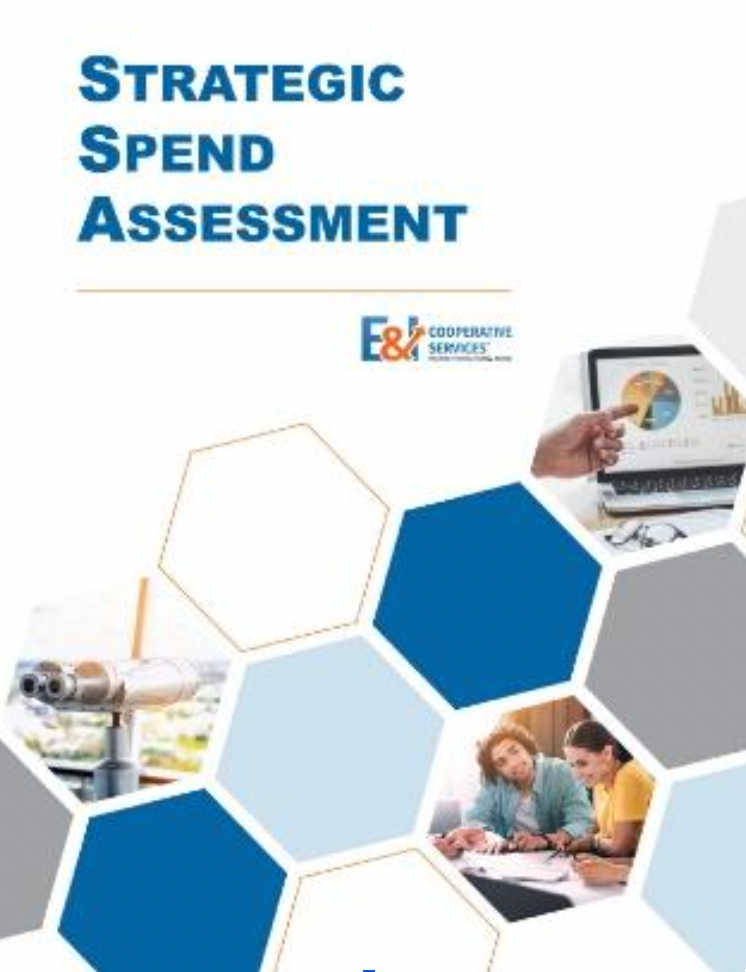
Strategic Spend Assessment
One of E&I’s most popular services is its no-cost
Strategic Spend Assessment (SSA), an easy-to-leverage consultative offering that can help uncover cost savings and efficiencies across your institution’s spend.