Maverick Spend in Higher Education: Risks, Impact, and Control Strategies
What Is Maverick Spend in Higher Education?
Maverick spend (often referred to as rogue spend) refers to purchases made outside an institution’s formal procurement process, approved vendors, or negotiated contracts. In smaller or decentralized campus environments, where individual departments or faculty often manage their own purchases, off-contract buying can proliferate.
Faculty and staff frequently make last-minute or convenience purchases (e.g. using purchasing cards or personal reimbursements) that bypass approved processes or agreements. These transactions can seem minor in isolation, but collectively, they can account for a significant share of spend that isn’t under central management.
Financial and Budgetary Impact of Maverick Spend
Off-contract purchasing very often has measurable financial consequences. Conservative estimates from procurement analysts are that colleges and universities lose up to 20% of negotiated savings when stakeholders purchase outside of approved contracts. (Source: iValua)
Every purchase made outside an approved agreement forfeits volume pricing, contract discounts, and rebates and other incentives that procurement teams worked hard to secure. Over a fiscal year, these lost savings really add up and erode already-tight university budgets. Additionally, budget predictability suffers. Inconsistent pricing and unmanaged purchases make it harder for finance teams to forecast spend accurately.
Fragmented spend also weakens leverage with preferred suppliers. The Hackett Group has found that 63% of organizations report that off-contract spend reduces their sourcing leverage and ability to get better deals. In short, maverick spend directly reduces the cost savings and economies of scale that higher-ed procurement or business leaders aim to achieve.
Universities also incur operational inefficiencies and overhead due to maverick spend. Reconciling many ad-hoc purchases, often lacking standard documentation or purchase orders, can create tremendous burden for procurement and accounts payable staff. Untracked spend introduces hours of extra work chasing invoices and resolving exceptions. Research indicates organizations with high levels of maverick purchasing spend significantly more time resolving spend than those with low maverick spend, which creates hidden costs in staff time and process complexity, ultimately draining resources that could be better directed toward strategic initiatives.
Compliance, Risk, and Audit Consequences
Maverick purchases bypass the oversight and controls built into a formal procurement process, raising significant compliance and risk issues. Policy compliance drops considerably when buyers go rogue, leading to audit challenges due to transactions not being properly authorized or documented. Repeated off-contract buying can even jeopardize contract commitments (e.g. minimum volume requirements) and lead to contractual penalties or lost supplier incentives.
Additionally,
supplier and quality risks increase: unapproved vendors haven’t undergone the usual vetting for financial stability, product quality, insurance, or regulatory compliance. This lack of vetting can expose the institution to subpar goods or services and potential liabilities. From a governance perspective, unmanaged purchasing undercuts an institution’s ability to ensure consistent safety, ethical standards, and competitive pricing across campus. The
lack of spend visibility also means small problems can go undetected until they escalate, eroding institutional value quietly over time.
When procurement processes are perceived as difficult or time-consuming, users are more likely to find alternative paths. Convenience often outweighs compliance.
Maverick Spend Across Key University Spend Categories
Maverick spend can occur in virtually
any procurement category on campus. The table below highlights common examples in higher education and how using competitively solicited contracts can mitigate the risk:
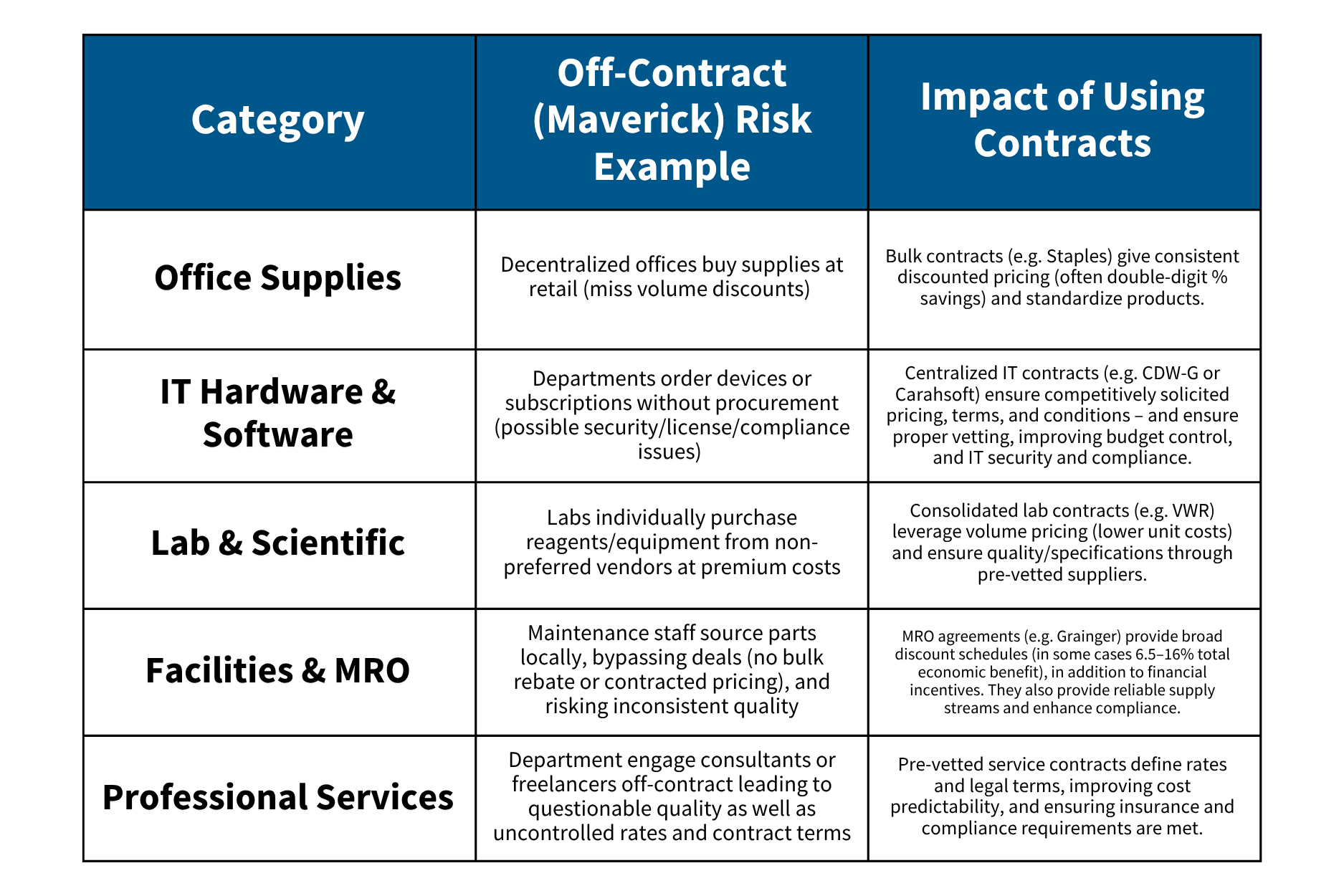
(NOTE: Examples above illustrate typical scenarios; actual savings and controls vary by institution and contract.)
75% of procurement professionals say a lack of self-service or guided-buying tools drives maverick purchasing.
Strategies to Reduce Maverick Spend
To curb maverick spend, it is critical to make the compliant path the path of least resistance. To accomplish this, procurement and finance leaders are focusing on a few key strategies in higher education:
- Guided Buying and E-Procurement Tools: User-friendly purchasing systems (with approved supplier catalogs and punch-outs) help channel department buyers to preferred contracts. Notably, 75% of procurement professionals say a lack of self-service or guided-buying tools drives maverick purchasing. By embedding contracts into easy-to-use platforms, institutions align convenience with compliance.
- Increase Spend Under Management: Expanding competitively solicited contract coverage across more categories leaves fewer gaps for maverick purchasing. You don’t have to do everything at once; sometimes, it pays to start with a few key categories, such as facilities or IT. The more spend funneled through centrally managed agreements, the more visible and controllable it becomes. Many universities are prioritizing higher contract utilization to capture cost savings and better data on spend patterns.
- Simplify Processes & Provide Support: Overly complicated or slow approval workflows can inadvertently encourage off-contract spending. Simplifying purchase approval steps and offering clear training and customer support encourages compliance. When buying through proper channels is fast and well-supported, faculty and staff are less tempted to bypass procedures.
- Enforce Policy and Monitor Compliance: Establishing policies like “No PO, No Pay” (no payment for purchases lacking a purchase order) can deter unauthorized spending. Meanwhile,
spend analytics and regular audit of transactions help identify maverick patterns early so procurement can intervene. This data-driven approach highlights areas or departments with high off-contract spend for targeted correction.
The Role of Cooperative Purchasing
Cooperative procurement is an effective model to combat maverick spend in higher education without adding unnecessary burden on individual institutions. The best cooperatives offer competitively solicited contracts across key categories. These can range from office supplies and IT to scientific equipment and more, each ensuring that they meet competitive bidding and compliance requirements. By tapping into a contract portfolio of competitively solicited suppliers, colleges and universities can quickly enable preferred agreements for campus-wide use, even in traditionally decentralized spend areas. This approach aligns with the needs of senior procurement and finance leaders: it drives spend under management while preserving the autonomy of campus departments to get what they need from a broad selection of approved vendors.
Conclusion
Reducing maverick spend is about regaining control and predictability in procurement without sacrificing service. By leveraging data, simplifying processes, and utilizing cooperative contracts and guided buying tools, higher-education institutions can recapture significant lost savings, improve compliance and audit readiness, and protect their budgets and reputations for the long term. Leveraging the
competitively solicited contracts and expertise of a strong cooperative is one avenue proven to make compliant purchasing easier and more effective across your entire campus.
About E&I Cooperative Services
E&I Cooperative Services (E&I) is the only member-owned, non-profit procurement cooperative focused exclusively on education. An ABACC partner, E&I delivers unsurpassed value and an exceptional experience to its members through a broad portfolio of competitively solicited contracts with industry-leading suppliers and innovative sourcing solutions. The Cooperative empowers its members to make informed, analytics-driven decisions to capture more spend and optimize their education dollars. For more information, please visit www.eandi.org.
Contact:
Jon Kokos, Sourcing Consultant, E&I | jkokos@eandi.org
Mike Price, Sourcing Consultant, E&I |
mprice@eandi.org